
The right development setup depends on how steady your workload is and how much technical capacity your agency needs. An in-house developer, a freelancer and a white-label partner each suit different ways of delivering WordPress work. This guide compares these delivery models and the practical commitments involved to help you choose the approach that best supports your team, projects and client relationships.
Key Takeaways
- Compare an employee’s full workload and responsibilities with the flexibility of freelance or white-label support.
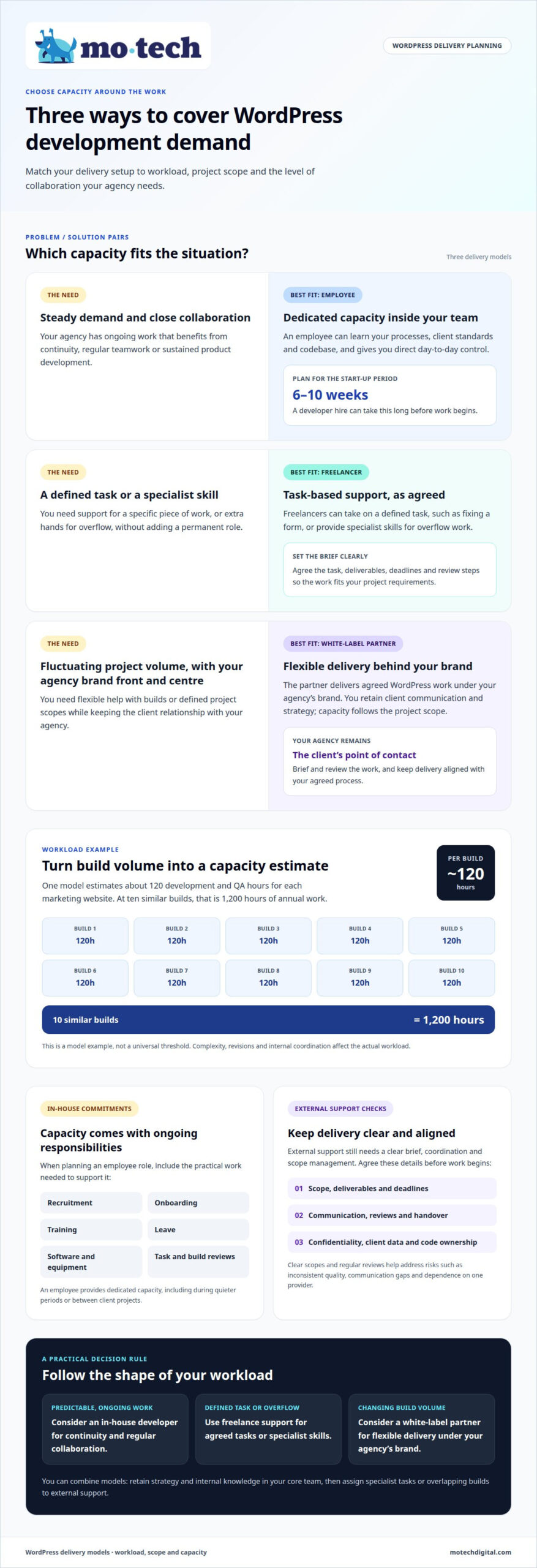
- Choose the support model around the work: in-house for steady demand, freelancers for defined tasks, and white-label partnerships for flexible delivery under your agency’s brand.
- Consider recruitment, onboarding, tools, training and management time when assessing what an in-house role requires.
- Match the development support to each project’s scope, then consider how mo•tech’s White Label WordPress Support could fit your agency’s delivery process.
Is a white-label developer right for your agency?
An employee and a white-label partner provide different kinds of WordPress capacity. The right fit depends on your workflow, project volume and how closely you need a developer embedded in your agency.
Employee Roles and Benefits
An employee joins your team and can learn its processes, client standards and codebase. Recruitment, onboarding, training and leave all affect when and how they contribute to client builds. This model suits work that calls for regular collaboration and continuity. A partner, by contrast, can take on defined work without becoming part of your internal team.
Equipment, Licences, and Management
An in-house developer needs suitable equipment, software licences and access to the systems used for WordPress work. Your team also assigns tasks, reviews builds and ensures development follows its standards. With external support, your agency still briefs and reviews the work, while the partner brings its own working setup and follows your agreed process.
Dedicated Capacity and Flexible Delivery
An employee provides dedicated capacity, including during quieter periods or between client projects. Freelance and white-label arrangements can focus on specific tasks or builds, giving you room to adjust support as demand changes. Review your project pipeline to see whether ongoing work or fluctuating peaks are the stronger pattern.
| Option | Working relationship | Capacity |
|---|---|---|
| Employee | Part of your team | Dedicated |
| Freelancer | Task-based | As agreed |
| White-label partner | Works behind your brand | By project scope |
White-Label Support and Project Scope
A white-label partner delivers under your agency’s brand, while you retain the client relationship. Agree on deliverables, review steps, communication routines and handover details before work begins. Risks include inconsistent quality, communication gaps and dependence on one provider. Clear scopes, regular reviews and written code ownership terms help keep delivery aligned with your standards.
Definitions of hiring, subcontracting and white-label partnerships
Hiring makes a developer an employee who works within your agency’s priorities, systems and team. Subcontracting assigns defined tasks to an external freelancer or business. In either arrangement, your agency remains responsible for coordinating delivery and maintaining the client relationship.
A white-label partner works behind your agency’s brand. You manage client communication and strategy, while the partner delivers agreed WordPress work according to your process. For your clients, your agency remains the point of contact.
You can combine these models. An employee might guide technical decisions and maintain internal knowledge, a freelancer could handle a specialist task, and a white-label partner could support overlapping builds. This lets you assign work according to its requirements without shifting ownership of the client relationship.
An in-house developer is a strong fit when demand is predictable and the role needs regular collaboration, continuity or sustained product development. A partner can suit short-notice capacity, specialist skills or fluctuating project demands. For example, your core team can retain strategy while external support helps deliver a busy run of client builds.
Before work begins, put the scope, deliverables, deadlines, communication routines and confidentiality terms in writing. Specify who owns custom code and other work product, and how client data will be accessed, handled and returned or removed when the engagement ends. Clear terms define responsibilities and help protect the client relationship.
If flexible technical capacity would support your agency’s process, explore white-label support options.
Comparing internal hires, freelancers and white-label support
The right option depends on scope, timing and how much delivery control you need. Compare similar WordPress work on an actual project basis.
Scope and Quote Comparison
A freelancer’s hourly or project quote can suit a defined task, such as fixing a form. A white-label quote may cover a broader build and agreed delivery steps. For a fair comparison, specify the same pages, functionality, revisions and handover requirements in each scope. Otherwise, quotes may cover different work, making the apparent cost difference misleading.
Per-Build Cost Comparison
One model estimates about 120 development and QA hours for each marketing website. At ten similar builds, that represents 1,200 hours of annual work. A separate comparison estimates hiring becomes cheaper per build at about 20 similar builds a year. Treat these as model examples, not universal thresholds; complexity, revisions and internal coordination affect the actual result.
Delivery Speed, Control, Expertise, and Scalability
An employee gives you direct day-to-day control, but recruitment and onboarding delay when they can start contributing. A developer hire can take six to ten weeks before work begins. Freelancers may provide specialist skills for overflow, while a partner can add broader capacity as project volume changes. Your agency still sets priorities and manages client communication, while delivery follows the agreed scope and process.
Hidden In-House Hiring Costs
The comparison should include recruitment, onboarding, training, leave, software, equipment and management time, not salary alone. These commitments remain even when project work fluctuates. External support reduces the need to build every skill internally, but requires coordination and scope management. Choose by matching actual demand, skills gaps and available management time to the arrangement.
Planning WordPress development support
Choosing between an in-house developer and white-label WordPress support depends on the work your agency needs to deliver and how you want to manage it. Consider the types of projects, the level of technical support required and how each option fits your existing workflows.
Available client hours can help you plan delivery. A working year is estimated at around 1,700 hours before time away from client work is deducted. Productive client-work time is often estimated closer to 1,200 hours after non-client tasks are removed. Meetings, training, leave and internal requests all affect the time available for builds.
To assess which approach fits your agency, list the WordPress tasks and projects you need covered, then consider who will manage delivery and communication. Compare the scope and delivery offered by white-label support with the capabilities and availability of your in-house team. This can help you plan how projects will be handled.
Consider the practical requirements of each approach too. Recruitment, onboarding and training take agency time, while supervision and quality checks draw on other staff. Equipment and software licences support the role, and your agency may need to plan how WordPress projects will be covered during quiet periods.
Write down the tasks your team needs covered and use the same period and scope when planning delivery. For example, consider the client builds and ongoing support your agency needs during a year. Focus on the client work to be delivered and how your team will manage it.
Plan your WordPress development support around the work your agency needs to deliver.
Mo•tech: White Label WordPress Support
mo•tech provides White Label WordPress Support for agencies that need help with WordPress work without adding an employee to their team. The work happens behind your brand, so you retain the client relationship and keep communication within your agency. It can suit you when projects overlap, WordPress support requests build up or your internal capacity is stretched.
Support includes development and maintenance for client WordPress sites. You remain responsible for the client relationship while mo•tech handles the agreed technical work in the background. This gives your agency a way to manage builds, fixes and ongoing support without introducing a separate provider to your clients.
For a new website or a project with requirements beyond standard capabilities, discuss the technical work your agency needs. You can keep strategy and client communication within your agency while agreeing the project scope with mo•tech.
The right support depends on the work you need to deliver. A defined build calls for a clear scope and handover. Ongoing technical requests call for a process that fits your agency’s communication and quality standards. If you are considering a change in ownership or transfer of client relationships, Agency Acquisitions may also be relevant to your plans.
Client feedback recognises mo•tech’s WordPress expertise, attention to detail, support during builds and project delivery. These strengths matter when technical work sits behind your agency’s reputation and client relationships.
If you want to discuss how this support could fit your agency’s delivery process, contact mo•tech about WordPress support.
Choose a delivery model that can grow with your agency
Your next step is to match your development setup to the work you want to take on. Look beyond this quarter’s project list. Consider which skills you need to keep close, where extra capacity would help and how you want clients to experience delivery as your agency grows.
Protecting time for client relationships, planning and quality control is part of the decision. You can keep strategic decisions with your team and bring in external technical support where it fits. It needn’t be an all-or-nothing choice.
mo•tech’s team brings WordPress expertise to agencies that want a steady technical partner behind their work. If you’re considering how that could fit your plans, discuss your options with mo•tech.
Frequently Asked Questions
When Should an Agency Hire In-House?
An agency should hire in-house when development is a continuing part of its core delivery, rather than occasional project work. A developer can build knowledge of your codebase, client standards and internal decisions over time. This suits product development that needs sustained investment and close collaboration. Before recruiting, consider whether future demand is predictable beyond projects already signed.
When in-house makes sense?
In-house can make sense when your agency needs daily input on custom functionality, technical direction and product decisions. A developer embedded in your team can work closely with designers and account managers, adapting as requirements change. This differs from bringing in help for a defined build or specialist task. The case is strongest when that knowledge will remain useful across ongoing work.
Do I Have to Manage the Resource Directly?
With an employee, your agency sets priorities, assigns work and manages performance. With a freelancer, you’ll usually coordinate the task, feedback and deadlines. A white-label arrangement can follow your agency’s process, while you retain responsibility for client expectations and the final brief. For example, gather a client’s requested changes and pass one clear set of instructions into delivery.
How much work justifies hiring a developer?
There’s no universal project count that justifies a hire. Look for predictable development work that can keep a developer productively occupied after meetings, internal requests, quality checks and leave. Review completed work alongside committed projects and recurring product needs. If demand is uneven, combining internal ownership with external support can help cover busy periods without hiring solely for peak workload.
What is the average UK salary for an in-house software developer in 2026?
A useful UK average for 2026 depends on role level, WordPress specialism, location and responsibilities. A general software developer benchmark may not reflect the skills your agency needs. Compare like with like by defining seniority and required experience first. Treat advertised salary separately from the wider employment commitment, which can also include equipment, training and management time.
What is the fully loaded annual cost of an in-house developer in the UK?
Work it out by adding the employee’s salary to employer on-costs, benefits, recruitment, onboarding, equipment, software, training and management time. Then account for the share of working hours available for client delivery. This gives you a more useful comparison with external support than salary alone. The total depends on the role, benefits offered and how much agency time supports it.