
You can scale a digital agency without adding developer payroll by keeping sales, strategy and client relationships in-house while assigning delivery work to a white-label development partner.
If you’re weighing how to scale a digital agency without hiring developers, the question is not just whether you can delegate work. It is whether delivery will stay consistent, communication clear and clients well cared for.
This article explains how a white-label model can create capacity without a permanent hire, when it fits and what to assess before using it: the work to delegate, the checks and updates you need, and the client relationships and decisions that should stay with your agency. It also covers the limits of the model, including the need for clear processes and documented work, so you can judge whether it will support growth or add friction.
Key Takeaways
- Keep client relationships, creative judgement and final review within your agency when delegating delivery.
- Track capacity and profitability to see whether extra work can be handled without adding permanent payroll.
- Choose between freelancers, partner teams and permanent hiring based on how predictable the workload is and how closely the work needs to be managed.
- Consider an acquisition or client transition when your plans for growth or exit call for a change in ownership or responsibility.
❓ Is white-label development risky?
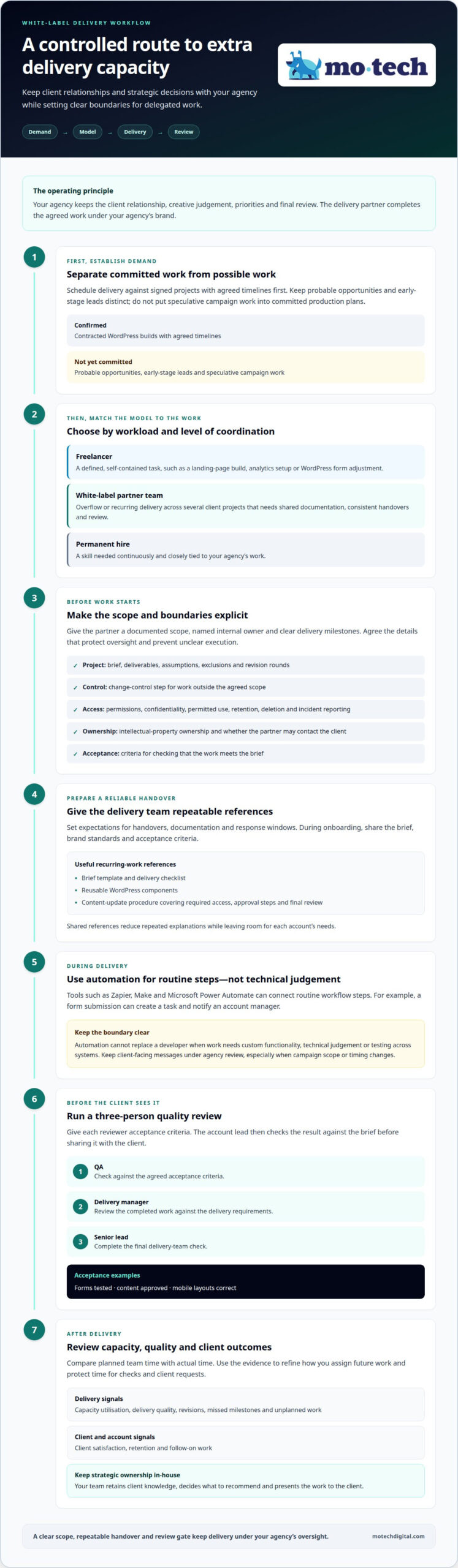
White-label delivery carries risks if you hand over client access, decisions and review without clear boundaries. Keep the client relationship, creative judgement, brief and scope-change decisions with your team. A delivery partner carries out the agreed work under your agency’s brand, so your client has one accountable relationship rather than a visible hand-off between suppliers.
Use the added capacity for work clients value. For example, your account lead can discuss a campaign improvement while technical support completes agreed WordPress changes. Your staff retain client knowledge and focus on goals; the partner supports delivery, while your agency decides what to recommend and how to present it.
Set a review gate before anything reaches the client. A practical model has three people check the work: QA, the delivery manager and a senior lead. Give each person acceptance criteria, such as tested forms, approved content and correct mobile layouts. The account lead then reviews the result against the brief before sharing it.
For UK client work, document data access, confidentiality, permitted use, retention and deletion, and incident reporting. Limit access to the information needed for delivery and define who can access it. Also agree intellectual-property ownership and whether the partner may contact the client.
Tools such as Zapier, Make and Microsoft Power Automate can connect routine workflow steps. For example, a form submission can create a task and notify an account manager. Keep client-facing messages under agency review, especially when campaign scope or timing changes.
Standardise recurring work with a brief template, delivery checklist and reusable WordPress components. A content-update procedure can define required access, approval steps and final review. Shared references reduce repeated explanations while leaving room for each account’s needs.
Track client satisfaction, retention and follow-on work alongside delivery quality. As existing accounts grow, your agency can identify useful next steps without weakening client relationships or handing over strategic decisions.
Can an agency grow without adding payroll?
Separate confirmed work from possible demand before adding capacity. Treat signed projects with agreed timelines differently from probable opportunities and early-stage leads. For example, schedule delivery against contracted WordPress builds first, and keep speculative campaign work out of committed production plans.
Freelancers can cover defined tasks, such as a landing-page build or analytics setup. They suit work with clear deliverables and limited ongoing coordination. A specialist can fill a skill gap without changing your permanent team, while your account lead retains client communication and strategic decisions.
Global talent can extend production capacity across working hours. Set expectations for handovers, documentation and response windows before work starts. During onboarding, share the brief, brand standards and acceptance criteria. Without these basics, time-zone differences can add delays rather than useful capacity.
A white-label partner can handle overflow when several projects need similar skills. Keep strategy and client ownership in-house, then assign the partner a documented scope and delivery milestones. This works best when tasks are reviewable and can be handed over cleanly.
Monitor capacity utilisation alongside delivery quality and profitability. Compare planned team time with actual time, then review revisions, missed milestones and unplanned work. If utilisation stays high, protect time for quality checks and client requests rather than treating every available hour as billable production.
Protect margins by defining deliverables, assumptions, exclusions and revision rounds before agreeing to a project. Set a change-control step for work outside the scope, and compare actual effort with the original plan. This gives you better evidence to plan future projects without committing to unclear execution.
If WordPress delivery is the constraint, explore white-label WordPress support as one way to extend production capacity.
White-label development partnerships
Choose a delivery model by considering how often the work recurs and how closely it needs to sit with your team. A freelancer may suit a self-contained task, such as adjusting a WordPress form. A partner team may fit better when delivery spans several client projects. Permanent hiring makes sense when the skill is needed continuously and closely tied to your agency’s work.
A white-label partner works under your agency’s brand and follows agreed processes. Your team sets priorities and remains responsible for the client relationship; the partner provides development capacity. This arrangement can help you scale a digital agency without hiring developers while keeping your client-facing service consistent.
Consider the shape of the work before choosing a model. A single, clearly defined task may be straightforward to assign to a freelancer. A stream of WordPress builds or maintenance requests may need shared documentation, consistent handovers and a dependable review process across projects.
Automation can help with routine tasks, such as creating an internal task from a submitted request. It cannot replace a developer when a project needs custom functionality, technical judgement or testing across systems. Match the tool to the task rather than forcing complex work into a standard workflow.
To outsource reliably in the UK, define the brief, deliverables, access permissions, intellectual-property ownership and acceptance criteria before work starts. Keep a named internal owner responsible for review and client decisions. These steps give a partner clear boundaries and help your agency maintain oversight.
Use project outcomes to refine your model. If similar requirements recur, a partner arrangement may support continued delivery. If demand stays irregular, choose a bounded engagement. This distinction helps you scale a digital agency without hiring developers or committing to a delivery structure that does not fit.
Risks and limitations of white-label development
White-label delivery can falter when a handover is vague. For a campaign landing page, define the brief, assets, acceptance criteria and who approves changes. Your agency retains positioning and client decisions; the partner handles agreed production. Without clear boundaries, revisions can blur into new work.
Quality may vary if the partner lacks context or review time. A senior reviewer should compare each build with the brief, test key user journeys and record unresolved issues before client review. If your processes rely on undocumented knowledge, the partner may miss small but important details, such as a form notification or mobile layout.
Access creates another practical risk. Give the partner only the permissions needed for the task, and agree confidentiality, intellectual-property ownership and client-contact boundaries in writing. Keep progress visible through agreed updates and named delivery owners. If access or ownership remains unclear, pause the handover until responsibilities are defined.
A dedicated partner may not suit one-off projects, agencies seeking a partner with a narrow service scope or teams unwilling to document their processes. A retainer also needs enough recurring, well-scoped work to make ongoing capacity useful. If demand is uncertain, start with a bounded project instead of reserving capacity prematurely.
White-label delivery cannot replace your agency’s strategic judgement, account knowledge or scope decisions. Keep those close to the business. Review delivery quality, revision patterns and client feedback after each project. If marketing plans change or a deadline moves, your account lead should explain the impact and reset expectations with the client.
Start with a documented project and agreed review points. That gives both sides a clear way to assess communication, handovers and finished work before widening the relationship. To discuss a practical white-label delivery setup, contact the team.
Mo•tech: Agency Acquisitions
mo•tech’s Agency Acquisitions service supports agency owners considering a sale, acquisition or transfer of client relationships. An agency acquisition is the purchase of an agency or its client relationships by another business. You might explore this route if retirement, a change in focus or delivery pressures make continued ownership less practical.
For an owner planning an exit, a clear picture of client accounts and ongoing commitments helps frame the transition. Consider which relationships may transfer, what work clients expect and how service continuity will be handled. A structured client transition plan can set out responsibilities and communication, reducing uncertainty for clients and the incoming business.
An agency considering an acquisition may want to take on established client relationships rather than build every account from scratch. The practical question is whether the work, expectations and delivery capacity fit the acquiring business. Reviewing the service mix and technical commitments helps both parties understand what needs to continue after handover.
Technical continuity matters during a change in ownership. White-label WordPress support can help an agency maintain delivery under its own brand, while Custom Builds or Managed Security can address specific WordPress needs. These services support delivery, but do not replace decisions about client ownership, communication or transition terms.
Consider an acquisition or transition when weighing an exit, taking on a client base or planning how existing accounts will be served under new ownership. mo•tech facilitates agency client-base acquisitions and transitions, focusing on practical arrangements and continuity. Contact mo•tech to discuss your agency acquisition or client transition.
Build the next stage around the work you want
Your next step is to decide what kind of agency you want to run, not simply how much work you can take on. Identify the projects that suit your strengths, the client relationships you want to protect and the delivery responsibilities that no longer need to sit with your internal team. This gives growth a clearer shape.
If you’re considering how to scale a digital agency without hiring developers, treat each delivery arrangement as an operating choice. Keep work that depends on your judgement close, and assign repeatable technical delivery with clear ownership and review. That distinction can help you grow while staying focused on the service your clients value.
mo•tech supports agency teams with White-label WordPress support, Custom Builds and Managed Security. The right starting point depends on the work you want to delegate and the delivery structure you need.
Contact mo•tech to discuss your options. A considered next step can help you build capacity while keeping your agency’s direction and client relationships in your hands.
Frequently Asked Questions
Can an agency grow without adding payroll?
Yes. An agency can increase delivery capacity through project-based freelancers, specialist partners, automation and clearer service packages. For example, a strategist can retain planning and client meetings while external support handles a defined production task. Growth still depends on having suitable work and a reliable way to coordinate it. Review client outcomes and team workload alongside new business.
What role does data and analytics play in scaling a digital agency, and how should agencies use it for growth?
Data helps you decide which services and client relationships deserve more attention. Review project completion, revision patterns, client feedback, recurring work and campaign outcomes together. For example, if reports show repeated delays around approvals, improve the approval process before expanding that service. Use analytics to inform decisions, not replace conversations with clients about their priorities.
What strategies should agencies use to scale their operations efficiently, whilst still maintaining quality and client satisfaction?
Standardise repeatable work while keeping client-specific decisions with the account team. A shared project brief, clear approval points and a consistent handover can reduce misunderstandings across delivery. Monitor feedback and recurring issues after each project. If the same quality problem appears again, adjust the process or review criteria before taking on more similar work.
❓ Can agencies really scale without hiring developers?
Yes, if development work can be assigned to suitable external specialists or partners while your agency retains oversight. This can suit WordPress maintenance, defined builds and recurring technical tasks. It is less suitable when work depends on deep, continuous internal product knowledge or constant collaboration. Decide based on continuity, complexity and the need for direct control.
❓ Is white-label development risky?
It can be, particularly when responsibilities, access and acceptance criteria are unclear. Reduce avoidable risk by documenting the brief, permissions, ownership and review process before work begins. Keep client communication and scope decisions with your agency, and inspect delivery against agreed requirements. A small, clearly bounded initial project can show how well the arrangement fits.
How do white-label development partners compare with freelancers and no-code tools?
Freelancers often suit individual tasks; a white-label partner can support ongoing delivery across related work. No-code tools can handle suitable workflows and standard functions, but they do not replace development when a site needs custom functionality or technical review. Choose by task: automate repeatable steps, assign bounded specialist work, and retain complex or sensitive decisions within your agency.