
The wholesale fee is only one part of a white label WordPress maintenance pricing model. Your service promise, client-facing responsibilities and retained workload matter too. To understand the real economics, consider how support requests and client expectations shape the work your agency still handles.
This guide explains what white-label maintenance can include, how wholesale and retail pricing relate, and which trade-offs matter to UK agencies. You’ll assess service scope, support boundaries and client billing, then weigh when outsourcing could ease your technical workload and when in-house maintenance may better suit your capacity.
Key Takeaways
- Understand how white-label maintenance lets you offer ongoing WordPress support under your agency’s brand while a specialist handles technical work.
- Weigh the time and capacity you may gain against the need to set clear service boundaries and manage the client relationship.
- Learn which maintenance tasks may sit in a plan and how optional work can affect its scope.
- See how wholesale and retail pricing relate, and identify the factors that shape a workable model for your agency.
What is white label WordPress maintenance?
White-label maintenance lets agencies and freelancers offer WordPress care under their own brand while a technical partner handles agreed tasks behind the scenes. Delivery can be organised by site, service tier or shared monthly retainer, according to the portfolio and support needs.
Agency and Freelancer Support
The partner works behind the scenes while your agency remains the client’s main contact. Maintenance may cover routine site care, support requests and branded reports, with responsibilities agreed in advance. Freelancers can use the same arrangement to access technical capacity without hiring for every task. Define what is included, such as routine fixes, and identify requests that need a separate project scope.
Outsourcing Maintenance Work
Outsourcing can reduce the time your team spends on recurring WordPress tasks, leaving more capacity for client strategy, design or development. It may suit agencies managing several websites without a dedicated maintenance role. A small portfolio may be simpler to maintain in-house if a technically skilled person has capacity. Either way, clarify who handles each request, updates the client and escalates work beyond the agreed scope.
Partner Costs and Client Billing
Organise delivery around the number of sites, the work included and the support each site needs. A basic tier might cover routine upkeep, while broader tiers can include more active support or technical tasks. E-commerce sites may need a distinct scope because their maintenance requirements differ from those of simpler websites. For a portfolio, a shared retainer can group agreed sites and tasks under one arrangement.
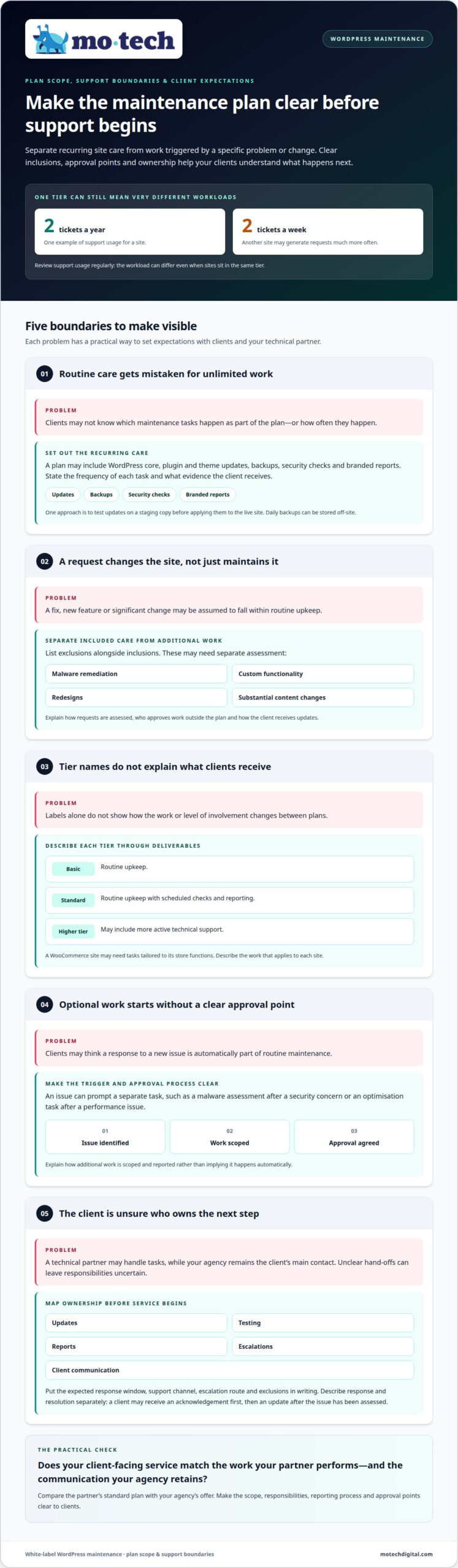
Keep control of your client offer by defining its boundaries and reporting process. Review support usage regularly: one site may generate two tickets a year, while another generates two tickets a week. This difference can affect workload even when both sites are in the same tier. Make sure your service description reflects the work your partner performs and the client communication your agency retains.
Benefits and drawbacks of white-labelling maintenance services
White-labelling can add recurring revenue without requiring your agency to employ a developer for every maintenance task. It can also free your team to focus on client strategy and new builds. The trade-off is shared responsibility: your agency still owns the client relationship, even when a partner handles updates or support requests. Agree who reports progress, manages escalations and explains work to clients before service begins.
A clear service description makes the offer easier to explain. Start with a client need, such as maintaining a WordPress site after launch, rather than listing technical tasks alone. Then define the difference between service levels: one tier might cover routine care, while another adds more hands-on support. Make those distinctions clear in the service description, reports and client conversations, so clients can see the practical value of ongoing support.
Marketing works best when the promise matches delivery. At project close, explain which tasks are included, how clients submit requests and what counts as additional development. Avoid implying that every fix or plugin issue falls within the same plan. If support is limited to a set allocation, state that clearly so expectations are realistic. Your team can discuss scope changes before recurring requests turn into unplanned work.
Service-level agreements should spell out response times and responsibilities. Put the expected response window, support channel, escalation route and exclusions in writing. A response time is not the same as a resolution time, so describe each separately. For example, a client might receive an acknowledgement first, followed by an update after the issue has been assessed. This structure supports the client relationship, while vague promises can create pressure that the working arrangement may not meet.
Before pitching, map the client’s likely support needs to the service’s actual boundaries. This makes the value specific, the marketing credible and the working relationship clearer for everyone.
Maintenance plan inclusions and optional upgrades
A clear maintenance plan separates recurring site care from work triggered by a specific problem or change. Describe the tasks, delivery process and approval point so clients know what happens after they submit a request.
Plan Inclusions and Exclusions
A plan may cover WordPress core, plugin and theme updates, backups, security checks and branded reports. One approach is to test updates on a staging copy before applying them to the live site; daily backups can be stored off-site. State how often each task happens and what evidence the client receives, such as a report of completed maintenance.
List exclusions alongside inclusions. Malware remediation, custom functionality, redesigns and substantial content changes may need separate assessment. Explain how requests are triaged, who approves work outside the plan and how the client receives updates. This gives your agency a consistent way to distinguish routine upkeep from work that changes the site.
Features Across Plan Tiers
Use tiers to distinguish the work and level of involvement, not just the labels. A basic tier might focus on routine upkeep; a standard tier could add scheduled checks and reporting. A higher tier may include more active technical support, while a WooCommerce site may need tasks tailored to its store functions. Describe each tier through concrete deliverables so clients can see which option suits their site.
Optional upgrades should have a clear trigger and approval process. For example, a security concern might prompt a malware assessment, while a performance issue could call for a separate optimisation task. Explain how these additions are scoped and reported rather than implying they happen automatically as part of routine maintenance.
Partner and Standard Plan Scope
Compare a partner’s standard plan with your agency’s client-facing service by mapping responsibilities side by side. Record who handles updates, testing, reports, escalations and client communication. This reveals any tasks your agency must manage itself and prevents gaps between the technical delivery and your service description.
For each site, record its platform features, maintenance needs and agreed exclusions. This helps your team route requests consistently as the portfolio changes.
White-label maintenance wholesale and retail pricing
Wholesale pricing is what your agency pays a maintenance partner; retail pricing is what you charge your client. The difference is not automatically profit. Your margin must also account for account management, support requests and time spent explaining reports. A white label WordPress maintenance pricing model should start with the work on both sides, not just a markup.
Start by matching the scope. A simple brochure site may need routine updates, backups and uptime checks. A WooCommerce store can require more active maintenance because its shop functions and hosting setup add requirements. If the partner’s plan excludes store-specific support, your retail offer should not imply that it is included. Record the covered tasks and identify anything that needs separate approval.
With a per-site model, each website has its own partner fee and client charge. This can make scope easier to track when client needs differ. A tiered model groups sites by service level, such as routine care or broader technical support. A monthly retainer may suit a portfolio with variable workloads, but define the sites and tasks it covers. Otherwise, an active site can absorb time intended for quieter accounts.
To protect your margin, record the partner fee, your team’s account-management time and any work outside the plan. Review actual requests and usage regularly, then adjust the tier or scope if the service no longer matches demand. Hosting, store complexity, security needs, reporting and response arrangements can all affect the wholesale-to-retail calculation. Your white label WordPress maintenance pricing model should reflect those requirements; the specific cost depends on the agreed scope.
The useful comparison is not simply the lowest wholesale rate. Check whether the partner’s defined work supports the service you intend to sell, and whether your client fee reflects the time your agency retains. If you need a delivery partner for white-label WordPress maintenance, discuss the sites and support scope involved.
Mo•tech: White Label WordPress Support
mo•tech provides White Label WordPress Support for agencies that want ongoing WordPress work handled behind their brand. It may be a practical next step when routine technical tasks are taking time away from client projects or your team needs additional capacity.
The work fits alongside your existing client relationship: your agency remains the client’s contact while mo•tech handles technical delivery in the background. For requirements beyond maintenance, related services include Custom Builds, Managed Security, and SEO & Performance. These can support broader client needs without changing your agency’s role.
Bring an outline of your sites, maintenance scope and support needs to the conversation. This gives the team useful context for discussing an arrangement that fits your agency. Contact mo•tech to talk through your WordPress support needs.
Set a maintenance model your agency can sustain
Your next step is to decide how maintenance should fit your agency’s client relationships. A workable white label WordPress maintenance pricing model must support the service you sell and the way your team operates. Keep the client experience at the centre: clients should understand what support includes, while your agency retains a clear role in the relationship. A considered structure can make ongoing care part of your agency’s way of working, rather than a collection of disconnected technical tasks.
mo•tech provides White Label WordPress Support, with Custom Builds and Managed Security for related WordPress needs. Its WordPress expertise supports agencies seeking a technical partner that works behind their brand. Start the conversation with your service scope, client needs and the work you want to keep within your agency.
Contact mo•tech about maintenance to discuss how support could fit your agency. A clear next step can help you build a service that works for both your team and your clients.
Frequently Asked Questions
Can I set my own pricing for clients?
Yes. Your agency sets the client-facing terms and decides how to package the service. Make the offer clear by naming included tasks, the support channel and when extra development needs separate approval. For example, you could offer routine site care as a recurring plan and scope a new feature as a separate project. This keeps the offer aligned with your agency’s approach.
How Does It Work?
Your agency remains the client’s point of contact while technical work is delivered in the background under your brand. A practical workflow starts when the client sends a request through an agency-branded support address. The technical team assesses it, completes work within the agreed scope and provides an update for your records. Your agency then keeps the client informed and handles requests that need a broader project discussion.
How do I stop support hours from eating my margin?
Separate routine requests from work requiring investigation, new functionality or a wider change. Track time by site and request type, then review which clients regularly need more help than their plan allows. If a request exceeds the agreed scope, explain the options before work proceeds. This gives you a clear basis for changing the service tier or agreeing a separate piece of work.
How does the white label billing work?
In a typical arrangement, your agency bills its client for the branded maintenance service, while the technical partner bills your agency for the agreed work. Your white label WordPress maintenance pricing model should account for both invoices and the client-management work your agency retains. Clarify who handles billing queries, renewals and scope changes so clients know whom to contact about each part.
How much do UK agencies pay per site for white-label WordPress maintenance?
There is no single per-site figure that fits every UK agency arrangement. A white label WordPress maintenance pricing model depends on the agreed scope, site requirements, support workload and need for specialist attention, such as for a WooCommerce store. For a useful comparison, assess the included tasks and your agency’s account-management work alongside the partner’s service, rather than comparing per-site figures without their scope.
What do white-label WordPress maintenance plans include at each price tier?
Plan tiers usually separate routine care from broader technical involvement. A basic tier may focus on updates and backups, while a higher tier may add more active support, reporting or security work. The names alone do not define the service. Compare each tier’s task list, exclusions and process for additional requests, then match the client’s needs to the appropriate scope.