
A white label web development SLA agreement template should define the services covered, support response targets and each party’s responsibilities, then set clear terms for exclusivity, intellectual property and branding. It works best when it reflects how your agency and its development partner actually deliver and support WordPress projects, rather than relying on broad promises.
It’s reasonable to expect dependable delivery without confusion over who speaks to clients, handles support requests or owns the work. Clear response targets distinguish acknowledgement from resolution, while specific ownership and brand-use clauses help protect client relationships and your agency’s reputation.
This article explains which terms to include, how to set practical support targets and what to consider when agreeing on exclusivity, intellectual property rights and white-label branding. Use it to shape an agreement around your working relationship and the support your agency provides.
Key Takeaways
- Define which services, features and limits the agreement covers so both parties understand what delivery includes.
- Set support responsibilities and response targets that distinguish acknowledging a request from resolving it.
- Make exclusivity, ownership and brand-use terms clear to protect your agency’s client relationships and reputation.
- See how mo•tech’s white-label WordPress support, custom builds, managed security, and SEO and performance services can support agency delivery.
What should be included in a White Label Solution Agreement?
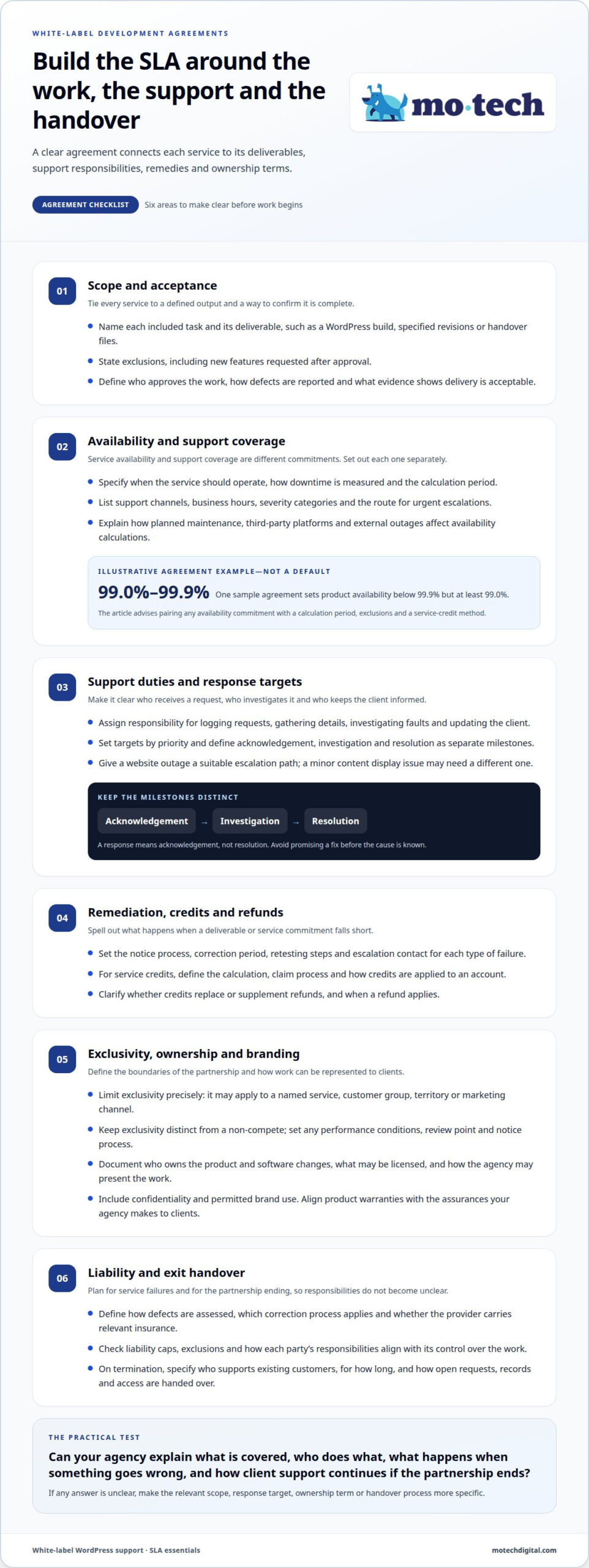
A white-label agreement should connect each service to its deliverables, exclusions and acceptance criteria. UK templates can provide a starting structure, but need adapting to your contract, payment terms and branding. Before signing, look for vague scope, unclear ownership of requests and remedies that do not match the service commitments.
Product Scope and Acceptance Criteria
A service scope names each included task, its deliverable and the acceptance criteria. Your contract might cover a WordPress build, specified revisions and handover files, while excluding new features requested after approval. Define who approves the work, how defects are reported and what evidence shows that delivery is acceptable. These terms help prevent a client request from quietly becoming extra work or disputed payment.
Availability and Support Coverage
An availability clause states when a service should operate and how downtime is measured. Set support coverage separately, including request channels, business hours, severity categories and response targets. Response means acknowledgement, not resolution; state both milestones to avoid false expectations. One sample agreement sets product availability below 99.9% but at least 99.0%. Pair any commitment with a calculation period, exclusions and a service-credit method.
Remediation, Credits, and Refunds
A remediation clause explains how the provider addresses a failed deliverable or missed service commitment. Specify the notice process, correction period, retesting and escalation contact for each type of failure. Service credits can address measured availability shortfalls, but define how they are calculated, when they can be claimed and how they are applied to an account. State whether credits replace or supplement refunds, and when a refund applies. Without these boundaries, agencies may struggle to explain remedies to clients or reconcile payment.
Customer support responsibilities and response-time SLAs
Set out who receives client requests, who handles the technical work and how each party reports progress. A useful SLA separates response targets from resolution commitments, helping your agency set clear expectations with clients.
Support Duties and Response Times
Support duties explain how the provider and agency handle requests, clarifying responsibility when software issues affect a client website. Name who logs each request, gathers details, investigates faults and updates the client. Set response targets by priority, with separate definitions for acknowledgement, investigation and resolution. A website outage, for example, may need a different escalation path from a minor content display issue. This structure helps your team explain progress without promising a fix before the cause is known.
Uptime and Support Channels
Uptime and support channels describe service availability and how users can reach the support team. List accepted channels, such as a ticketing platform or email, and identify who handles urgent escalations. If telephone support is included, state when it can be used and how calls are recorded. Explain how planned maintenance, third-party platforms and external outages affect availability calculations. Your agency can then give clients a consistent way to report problems and track updates.
Keep quality standards, warranties and liability distinct. Define how defects are assessed, what correction process applies and whether the provider carries relevant insurance. Clarify who holds rights to software changes and intellectual property, unless the contract assigns them differently. On termination, specify who supports existing customers, for how long, and how open requests, records and access are handed over. These terms reduce disruption when a partnership ends or responsibility shifts. White-label WordPress support can keep technical work behind your agency’s client relationship, while the SLA sets out how requests move between your team and the provider.
Exclusivity in white-label arrangements
Exclusivity limits which parties can sell, develop or promote a defined service. State whether the restriction covers a named product, customer group, territory or marketing channel. For example, exclusivity for a specific WordPress service need not prevent either party from working on unrelated projects. Define the boundaries precisely so the partnership does not unintentionally restrict other agency work.
Separate exclusivity from a non-compete term. Exclusivity may reserve a product or market for one reseller, while a non-compete can restrict wider business activity. State any minimum performance commitment, such as agreed sales activity or service standards, required to keep the restriction in place. Set a review point and a notice process for ending it if either party’s plans change. Without clear conditions, the restriction can outlast its business purpose.
Product warranties should identify what the provider promises and what happens if the product fails. Set out the reporting process, remedy and any exclusions, such as changes made without approval. Keep warranty promises aligned with the assurances you make under your own branding. Otherwise, your agency may be responsible to customers for commitments the provider has not agreed to meet.
Liability terms need equal care. One sample agreement caps the supplier’s aggregate liability by reference to amounts paid in the twenty-four (24) months preceding the date on which the claim arose. Treat that as a drafting example, not a default rule. Check which claims fall within the cap, which exclusions apply and whether each party’s responsibilities match its control over the work. Confirm how notice, approval and evidence of loss affect a claim.
Intellectual property and branding
Document who owns the product, what you may license and how your agency can present it. Include confidentiality, permitted branding, sublicensing and what happens after a breach. These clauses protect client relationships and clarify what each party can do with the work.
Licensee Branding and Sublicensing
A licence grants the reseller defined rights to market and distribute a product under its own brand. State whether you can sell access to end users, provide customer support and sublicense use to clients. Define any limits on copying, modifying or transferring access. A sample white-label arrangement might give the provider ownership of the product, source code and core technology, while the reseller receives specified marketing and distribution rights.
Permitted Branding and Territories
Permitted branding sets out where and how your agency may use its name, logo and visual identity. Specify whether the provider’s name may appear in software interfaces, documentation or client communications. Define the territory and channels covered by the licence, including your website and proposals. If you customise colours or labels, record the approval process and distinguish those changes from ownership of the underlying product.
Confidentiality and Intellectual Property Clauses
Confidentiality clauses identify protected information, permitted access and the period obligations continue after termination. A template may require that period to be specified in the agreement. Separate pre-existing tools, source code and core technology from commissioned deliverables, then state the ownership or licence applying to each. For client data, a UK controller engaging a processor needs a written contract or other binding legal act containing required terms. Set mutual duties for safeguarding information and explain how a breach is reported and addressed. These boundaries also matter when white-label WordPress support is delivered under your agency’s brand.
Mo•tech: White Label WordPress Support
mo•tech supports agencies with WordPress delivery and ongoing technical work behind their own client relationships. Its White Label WordPress Support is provided under your agency’s brand, keeping the client relationship with you while technical work happens in the background. Clear agreement terms can define the scope, responsibilities and communication route.
Use this support when your team needs help with WordPress maintenance or technical requests without bringing every task in-house. Your SLA can define which requests are covered, how your agency shares relevant details and how progress updates fit into your existing client communications. This gives your team a practical basis for setting expectations with clients.
For projects that need a new site or tailored features, mo•tech also provides Custom Builds. Define the agreed project scope and deliverables in the contract, including the features being built and the criteria for accepting the work. This keeps the build aligned with the requirements agreed with your client.
Managed Security covers the security side of WordPress work. Agencies can include it when security support is part of the client’s needs, with responsibilities and related work clearly recorded in the service agreement. Defined roles help prevent confusion about who handles each part of the arrangement.
SEO & Performance covers technical SEO and performance optimisation. It can suit projects where site performance or technical search considerations are part of the agreed work. Set out the specific tasks and reporting arrangements so your agency can explain the work without implying guaranteed rankings or business results.
Together, these services give agencies options for development, support, security and performance work. The right fit depends on the client’s needs and the responsibilities your agency wants to retain. Setting out those requirements helps shape a clear working arrangement.
Get in touch with mo•tech to discuss your agency’s WordPress requirements.
Set up a working relationship that lasts
A white label web development SLA agreement template can be a useful starting point, but its value depends on how well it fits your agency’s client work. Treat the agreement as a working document. Review it when delivery arrangements, support scope or client responsibilities change, so the terms keep pace with the relationship.
Technical delivery shapes the client experience, even when the work happens behind the scenes. mo•tech provides WordPress expertise through White Label WordPress Support, Custom Builds and Managed Security. These services can help agencies meet technical needs while keeping client relationships in their own hands.
Use the agreement to give both parties a clear operating framework, and keep communication open as the work evolves. Clear terms and suitable technical support can help your agency manage delivery with greater confidence.
Discuss your SLA with mo•tech and consider a practical next step for your agency.
Frequently Asked Questions
Should you include an SLA (Service Level Agreement)?
Yes, use an SLA when an external partner contributes to services your agency relies on. It provides a shared operating reference if staff change or a disagreement arises. For a one-off task, a project-specific agreement may be more proportionate. Consider how often the work recurs, how closely it affects client delivery and whether both parties need a consistent process across projects.
What other documents should you look at?
Alongside the contract, review the project brief, access register and handover records. The brief captures the client’s intended outcome; the access register records which accounts or systems each party can use. Handover notes help another team member understand ongoing work if the usual contact is unavailable. Keep these records aligned with the agreement, and remove outdated versions from active use.
What should a white-label web development SLA agreement include?
The agreement should identify the parties and its duration, explain how changes are approved and state which document takes precedence if terms conflict. For example, a signed project schedule can override a general service description for that project. A white label web development SLA agreement template is a useful drafting aid, but make sure its schedules, defined terms and signature blocks match the actual parties and arrangement.
What service levels and uptime guarantees are typical in web development SLAs?
There is no single typical target for every web project. A development agreement may cover work on code, while hosting availability depends on the systems running the site. For a WordPress website using third-party hosting or extensions, identify which components the provider controls and how dependencies affect any service measure. This helps avoid treating a development commitment as a promise about every part of the website.
How should response and resolution times be defined by issue severity?
Define severity by observable impact, not labels alone. For example, specify whether a fault blocks a key user task, affects one page or has a workable alternative. Also state when the response clock starts, what information a request must include and whether the clock pauses while your agency provides access or reproduction steps. These details make issue handling easier to apply consistently across your team.
How should an SLA define scope, deliverables, revisions, and change requests?
Use a project record to connect each deliverable to its source material, dependencies and client sign-off. For a custom page, that might include the approved design file and content supplied by your client. Record who can request changes and how decisions are documented. This creates a traceable project history, which is useful when a later request refers to an earlier design or approval.