
An in-house developer isn’t automatically the safer choice for an agency. Choosing between an in-house developer and a white-label WordPress partner comes down to where you need dependable capacity: an employee works within your team, while a partner handles agreed WordPress development and maintenance behind the scenes. Your agency retains the client relationship and presents the work under its own brand.
It makes sense to want control over quality and client communication, especially when your agency’s reputation is behind every site it delivers. This guide explains what white-label WordPress development involves, compares its support and workflows with in-house hiring, and helps you decide which setup suits your workload and priorities as your project pipeline changes.
Key Takeaways
- Match your development model to the work you need to deliver and the level of control your team wants to retain.
- Keep client communication and agency branding clear when technical development is handled in the background.
- Map support, quality checks and post-launch tasks into a workflow that protects the client experience.
- Find practical ways to reduce manual agency work, and plan client transitions carefully during an agency acquisition.
What Is White-Label WordPress Development?
In a white-label arrangement, your agency keeps the client relationship and presents WordPress work under its own branding. You gather requirements, remain the main contact and present the finished site as your agency’s work. If the client requests revisions, you pass them on to the development team. For example, your account manager can lead a redesign while a partner builds its pages.
A partner can help when several projects arrive at once or a build requires skills your team lacks. Unlike a freelancer engaged for one task, a white-label partner can provide coordinated development and remain invisible to your client. You retain strategy, communication and presentation; the partner handles the agreed technical work. This keeps your agency’s branding and the client’s familiar point of contact in place.
When assessing a UK partner, review its WordPress expertise, relevant project experience, testing process, communication and approach to deadlines and urgent requests. Ask how progress and revisions will be reported, and agree on those processes before work begins.
Cover confidentiality, access to client information, ownership and reuse of deliverables, scope, milestones, revisions and responsibility for defects in the partnership agreement. Specify who can access project files and how client data will be handled.
In-House Developer vs White-Label WordPress Partner
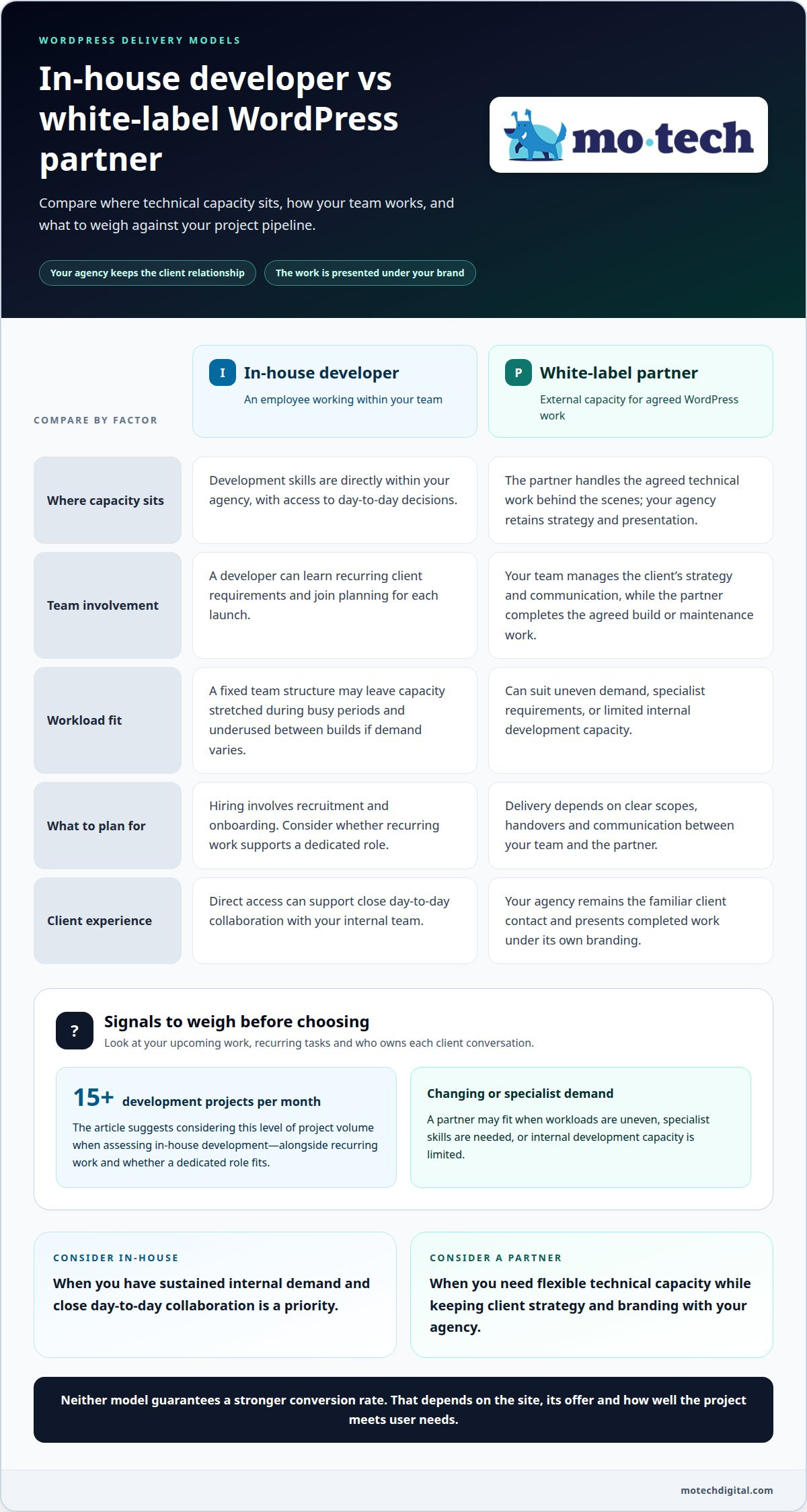
An in-house developer gives your agency direct access to WordPress skills and day-to-day decisions. They can learn recurring client requirements and join planning for each launch. Hiring also means recruitment and onboarding, so assess the steps involved rather than assume a 3-6-month timeline. If project demand varies, that fixed team structure may leave capacity stretched during busy periods and underused between builds.
A white-label partner provides external development capacity for agreed projects. For example, your team could manage a client’s commerce strategy while the partner builds the WordPress store. Your agency retains the client relationship and presents the completed work under its branding. This can suit a changing workload, but successful delivery depends on clear scopes, handovers and communication between teams.
Consider in-house development in light of your agency’s project volume, including whether you handle 15 or more development projects per month. Also consider recurring work and whether a dedicated role fits your needs. A partner can suit agencies with uneven demand, specialist requirements or limited internal development capacity. Neither model guarantees a stronger conversion rate; that depends on the site, its offer and how well the project meets user needs.
For your decision, map upcoming projects, recurring tasks and who owns each client conversation. Choose in-house for sustained internal demand and close day-to-day collaboration. Choose a partner when you need flexible technical capacity while keeping client strategy and branding with your agency.
White-Label WordPress Support and Client Workflows
Give each WordPress request a clear route from client report to resolution. Your agency can log the issue, assess its impact, then assign the work to the development team. A shared ticket or project board records the owner, status and next step. For a larger build, a weekly 20-minute call or Loom update can keep decisions moving without adding repeated email threads.
Maintenance can include updates, security monitoring and feature enhancements after launch. For example, a WooCommerce update may need testing before it reaches a live shop. Quality assurance can cover mobile responsiveness, cross-browser behaviour, performance, security, SEO readiness and bugs. Reviewing the work on a staging site lets your agency gather feedback before approving a release.
After launch, agree how support requests are received, prioritised and reported. A concise report can record completed fixes, outstanding issues and planned maintenance, giving your account manager clear updates to share with clients. Optimisation can also address specific needs, such as loading performance or a technical SEO issue. Before a proposal is finalised, a written brief helps define scope, deliverables and dependencies. Record who approves changes and how new requests affect the scope.
White-Label WordPress Development and Hosting Services
A white-label team can build WordPress sites, create custom themes, develop plugins and add WooCommerce features. It can also connect external systems through API integrations or migrate an existing site. Your agency can keep client strategy, content and campaign delivery in-house while the technical work follows the project brief.
Hosting work may involve setting up the environment, preparing a site for launch and coordinating a migration. Before work begins, agree who manages hosting access, backups, updates and security tasks. Clear ownership helps prevent gaps between development and ongoing site care. For example, an agency focused on branding and SEO can assign a complex plugin build to a partner, then review the work before presenting it to the client.
Outsourcing can help when project demand exceeds your team’s technical capacity or a build requires specialist WordPress skills. Keep the scope specific: list the required features, integrations, launch checks and handover materials. This helps your agency protect time for its core services without losing oversight of the client relationship.
UK GDPR and data protection risks include exposing personal information through excessive account access, insecure file sharing or unclear data handling. Reduce exposure by limiting access to what the project requires and agreeing confidentiality, access controls, data handling and intellectual property ownership in writing.
AI Tools and Automation for Agency Workflows
AI automation can reduce routine agency admin without taking client judgement out of your team’s hands. For example, a website enquiry can create a CRM record, assign an owner and send an acknowledgement. AI can summarise meeting notes, group support requests by topic or draft a response for staff review. Your team still decides what the client needs.
A WordPress-integrated workflow can create an internal task when a client submits a content update, then notify the account manager when the technical work is complete. AI can turn a project brief into draft requirements, helping staff spot unanswered questions before work starts. Keep approval with a person: an AI draft should not become a client promise or go live without review.
Start with one repeatable process. Record its trigger, automated action, responsible person and exception path. Test an approval reminder internally before connecting it to a live client workflow. Then review whether it reduces manual handovers and makes failed tasks visible. Automation should support client communication, not make your service feel impersonal. Clear ownership keeps a person accountable when the workflow requires judgement.
Agency Acquisition and Client Transitions
An agency acquisition is the purchase of an agency or its client relationships by another business. For a WordPress agency, continuity depends on more than transferring a client list. The incoming owner needs a clear view of active projects, site access, hosting arrangements, support commitments and each client’s main contact.
Build a client transition plan before changing responsibilities. Record each client’s current services, renewal dates, open requests, website credentials and agreed next steps. Assign a named contact for every account, then plan how the outgoing and incoming teams will introduce the change. A clear handover helps clients know who to contact and what will happen to their websites.
Keep technical work steady during the transition. Map maintenance tasks, updates and unresolved issues, then transfer access securely to the people responsible. If development capacity changes, arrange cover before the handover so existing projects can continue with clear ownership. Keep client communication direct and consistent: explain the new contact and service process in plain language.
If you’re planning an agency acquisition or need technical continuity for transferred WordPress clients, discuss your agency transition with mo•tech.
Mo•tech: White-label WordPress support
mo•tech provides White-label WordPress support for agencies that need technical work delivered under their own brand. When project demand rises or a client needs development capacity your team cannot provide in-house, mo•tech can support delivery while you retain the client relationship and lead communication.
Custom Builds support WordPress projects that need tailored development. Managed Security addresses website security, while SEO & Performance covers technical SEO and performance optimisation. These services add technical capacity around your agency’s existing work without changing the client’s main point of contact.
This can suit an agency with strong client relationships but limited in-house WordPress support, or one managing concurrent builds. Your team sets priorities, shares the brief and reviews the work; mo•tech handles the agreed technical delivery. Responsibilities stay clear, and your agency remains in front of the client.
If your workload calls for additional WordPress development or ongoing technical assistance, mo•tech offers practical support behind your agency’s brand. Contact mo•tech to discuss your agency’s WordPress support needs.
Choose the Setup That Gives Your Team Room to Deliver
The right development model should support the kind of agency you want to run, not just the projects already in your pipeline. As your client base and priorities change, revisit who owns technical decisions, how work is handed over and where your team needs more capacity. A clear division of responsibility helps protect your agency’s standards while keeping the client experience consistent.
Use your next project as a practical test. Define the work your team wants to keep close, the tasks it can delegate and how you’ll assess a successful handover. That gives you a grounded basis for the in-house developer vs white-label WordPress partner decision, rather than assumptions about either model. mo•tech provides WordPress expertise for agencies that want technical delivery to sit discreetly behind their client relationships.
If you’d like to discuss what would suit your agency, contact mo•tech about your project. You can take the next step at a pace that works for your team.
Frequently Asked Questions
What is White Label WordPress Development?
White-label WordPress development lets an agency provide technical work under its own brand without presenting the delivery team as a separate client contact. For example, a client can send a website issue to an agency-branded support address while the agency coordinates the work behind the scenes. The agency remains responsible for the client relationship and decides how to communicate progress and completed work.
What Does the Development Process Look Like?
A clear process starts with a brief that records the client’s goals, required features, existing integrations and launch expectations. The agency and development team then agree on the scope, milestones and review points. Work can be prepared on a staging site, where the agency reviews key pages and functionality before launch. After approval, the team coordinates the release and hands over relevant project information for future maintenance.
What does an in-house WordPress developer do compared with a white-label WordPress partner?
An in-house developer works as part of your agency, joining internal planning and taking ongoing responsibility for technical decisions. A white-label partner provides development capacity for agreed work while your agency manages the client relationship. For example, your employee might maintain a shared codebase across client projects, while a partner builds a bespoke integration for one campaign site.
What are the pros and cons of hiring an in-house WordPress developer?
An in-house developer can build detailed knowledge of your agency’s standards, client sites and internal processes. They’re part of your team’s planning and can support ongoing technical decisions. The trade-off is a continuing staffing commitment, and one person may not cover every specialist need. Consider the expected workload, required skills and how work will be covered during leave.
What are the benefits and drawbacks of using a white-label WordPress agency?
A white-label agency can give you access to a wider range of development skills without adding each role to your staff. This can suit project peaks or work outside your team’s usual expertise. The arrangement also requires clear briefs, review points and ownership of client communication. If handovers are weak, your agency may spend extra time clarifying requirements or coordinating revisions.
How do in-house and white-label teams compare on speed, quality and scalability?
Compare the models by how quickly each team can start, how well it follows your quality standards and how its capacity fits changing project demand. Speed depends on workload, project readiness and timely decisions. Quality relies on clear standards, testing and review. An in-house developer supports steady internal demand; a partner can provide capacity that adjusts to project needs. The right choice depends on your workflow and the level of control your agency needs.