
A website can stay online and still need regular care. White label WordPress support lets an agency hand routine maintenance to a specialist while keeping the client relationship under its own brand. Work may include core, plugin and theme updates, backups, security checks and fixes for routine faults.
This support can ease pressure on an agency team, but the handover needs clear boundaries. Agree who handles incoming requests, how updates are tested and what happens if a change causes a problem.
This guide covers what maintenance can include, how to organise support and updates, and what to consider when choosing an agency partner. You’ll get a clearer view of where outside support can help, what to agree before work begins and how to maintain consistent service for your clients.
Key Takeaways
- Understand which routine maintenance tasks a white-label arrangement can cover and how an agency can resell that work under its own brand.
- Set clear request routes, responsibilities and service expectations to keep client communication straightforward.
- Use a controlled update process, with changes tested before they reach a live site.
- Choose a partner whose support terms, security work and delivery process fit the needs of your agency and its clients.
What is white label WordPress maintenance?
White-label maintenance lets an agency outsource technical care for a client’s WordPress website while presenting the service under its own brand. The agency manages the client relationship, while a specialist handles the agreed site work behind the scenes.
Agency Reseller Arrangements
In a reseller arrangement, the agency defines the client-facing scope and recurring fee, then pays a partner to deliver the agreed maintenance. The difference can contribute to agency margin, provided support time and partner costs are accounted for. A freelancer provides direct technical capacity; an in-house developer offers closer control but requires ongoing staff capacity. Outsourcing can suit agencies that need delivery support without hiring.
Data Protection for Outsourced Support
Where support involves personal data, UK GDPR makes clear data-handling roles and responsibilities essential. The agency and provider should define permitted access, instructions, security responsibilities and how data is handled when support ends. Risks include excessive account access, unclear responsibility for faults and client requests being missed between teams. A written agreement should specify covered work, request routes, response expectations, access controls, confidentiality, incident escalation and exit arrangements.
Included Support Plan Services
Plan contents vary, so specify each task rather than relying on the word “maintenance”. A plan may cover WordPress core, plugin and theme updates, backups, uptime checks, security monitoring, troubleshooting and an allowance for routine changes. Some plans also include reporting or small content edits. Clarify how clients submit requests, which tasks are included and how separate development work is handled. This gives the agency a clear basis for explaining recurring maintenance fees to clients.
Support workflows and client relationship protection
A clear workflow keeps client communication with the agency and technical delivery with the support team. The agency receives a request, records the affected WordPress site and routes the task through an agreed channel. The partner takes ownership and reports progress through the same route. This avoids duplicate instructions and gives the client one familiar point of contact.
Define each stage of the process. For example, a broken form can be logged, assessed, fixed and reported to the agency. Set response expectations by request type, and explain how urgent faults differ from routine edits. A service level agreement should describe expectations, escalation steps and the information each update includes. Proactive status messages help the agency keep clients informed without chasing technical details.
Keep wholesale costs and client-facing prices in separate records. The agency’s margin depends on partner costs, the client fee and the time spent managing requests. Track each site, plan, invoice and support allocation in one client-management system. A defined allowance, such as two hours per month, gives both teams a practical boundary. Log work against it so any overage is visible before billing.
Overage rules should explain which tasks fall outside the plan and how extra work is approved. A new landing page, for instance, may need a separate estimate rather than being treated as a small edit. Track request volume, handling time and repeat issues across the client list. These records help refine plan scopes and identify recurring technical problems.
Start onboarding with a site inventory: hosting details, WordPress access, active plugins, backup arrangements and known issues. Confirm client approval for access, then share only the credentials needed for the agreed work. Record the site’s baseline condition and the route for future requests. This gives the partner useful context before its first update while keeping the agency in charge of client communication.
WordPress core, plugin and theme updates
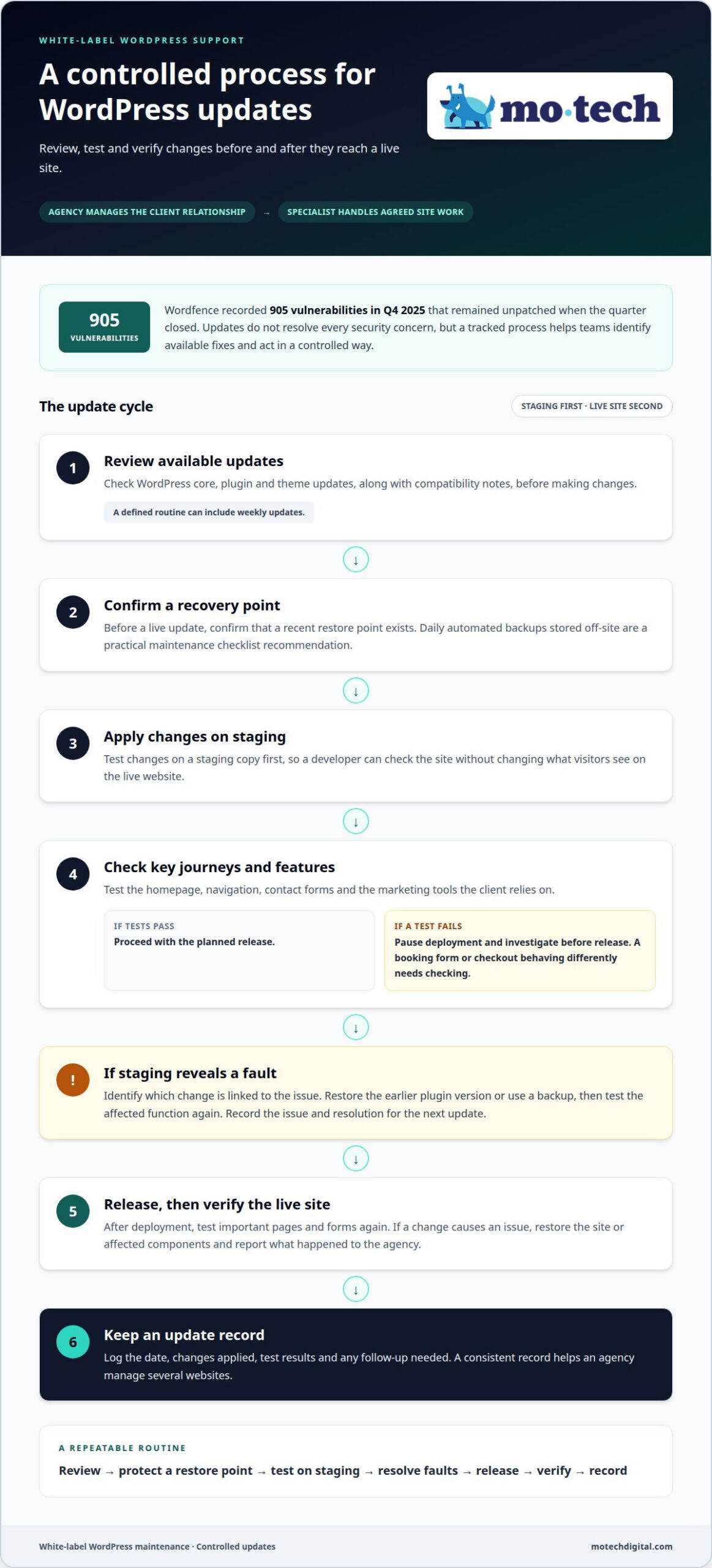
WordPress updates keep a website’s software current, but changes can affect connected features. A maintenance process should cover core, plugin and theme updates, followed by testing before changes reach visitors. A defined routine, such as weekly updates tested on a staging copy, helps make this work consistent. Staging lets a developer check key pages and forms without first changing the live website.
The sequence matters. First, the developer reviews available updates and compatibility notes, then applies changes on staging. They can test the homepage, navigation, contact forms and marketing tools the client relies on. If a booking form or checkout behaves differently, investigate before release. This lowers the risk of a routine change disrupting a working customer journey.
Plugins can conflict when updates change how they interact with WordPress, a theme or other extensions. If a staging test fails, pause deployment and identify which change is linked to the fault. The developer can restore the earlier plugin version or use a backup, then test the affected function again. Record the issue and resolution against the website to give the next update useful context.
Backups support recovery, but work best as part of a planned process. Daily automated backups stored off-site are a practical maintenance checklist recommendation. Before a live update, confirm that a recent restore point exists; after deployment, test important pages and forms again. If a change causes an issue, restore the site or affected components and report what happened to the agency.
Security also makes timely maintenance relevant. Wordfence recorded 905 vulnerabilities in the fourth quarter of 2025 that remained unpatched when that quarter closed. Updates alone don’t resolve every security concern, but a tracked process helps teams identify available fixes and act in a controlled way. Keep an update log with the date, changes applied, test results and any follow-up needed. That record helps agencies manage several websites consistently.
Choosing a white-label WordPress partner
UK digital agencies and specialist WordPress providers offer maintenance that agencies can resell under their own brand. Look for a partner with a clear delivery process, agreed responsibilities and support suited to your clients’ websites.
Start by matching the service to the sites you manage. A brochure site may need routine updates and fault handling; a WooCommerce store also relies on checkout and payment journeys working correctly. Ask for a sample monthly report that shows completed work, outstanding issues and relevant uptime information. A useful report gives your team material for client updates, not just a list of technical tasks.
Separate security monitoring from emergency response. The partner should explain what its monitoring covers, how an alert is handled and who informs your agency. The selection criteria include whether it offers 24/7 security monitoring and uptime tracking. Monitoring does not, by itself, establish when a person responds or what support follows. The service agreement should define response expectations for different request types.
Test the working relationship before moving a large client portfolio. Use a suitable site to assess onboarding, communication, update reporting and escalation when an issue arises. Review how the partner handles a failed change and whether your agency receives enough detail to explain the outcome. This practical test can reveal gaps that a sales conversation might not.
Then assess the commercial fit. Compare the partner’s scope with the monthly fee your agency plans to charge, including the time spent managing requests and reporting to clients. A workable arrangement should leave room for agency revenue while clearly explaining what each client receives. Agree how additional development is scoped, how access is controlled and how sites will be transitioned if the relationship ends. Clear boundaries protect continuity as well as margin.
Choose based on the delivery process, not presentation alone. A partner that explains monitoring, reporting, access and escalation clearly gives your agency a more dependable basis for client service.
Mo•tech: White Label WordPress Support
mo•tech provides specialist WordPress maintenance for agencies that need dependable technical delivery behind their own client relationships. Its white label WordPress support can help when routine site work is taking time away from strategy, campaign delivery or account management.
For agencies planning a new site alongside ongoing maintenance, Custom Builds cover bespoke development. Managed Security supports sites that need focused security work. White label WordPress support can complement these services, with the scope tailored to the work your agency wants to hand over.
Ready to discuss white label WordPress support for your agency’s sites? Contact mo•tech.
Set a clear starting point for support
Start by defining the first work you want to hand over. Choose a clear boundary, such as ongoing maintenance for a group of sites or a distinct stream of technical requests. This gives your agency a practical way to assess the arrangement without changing every client workflow at once.
Set the intended outcome in operational terms: fewer routine tasks reaching account managers, steadier delivery across sites or more internal time for client strategy. A white label WordPress support arrangement should support that goal while leaving your agency in control of the client relationship. Keep the initial scope focused, then adjust it as the process becomes part of normal delivery.
A clear starting scope also makes ownership easier for your team to explain and manage. If you’re ready to discuss a handover that fits your agency’s workflow, contact mo•tech about WordPress support. A considered first step is enough to begin.
Frequently Asked Questions
How do agencies profit from white-label development?
Agencies earn by packaging specialist delivery into a clearly scoped client service with their own fee. For example, an agency might include a bespoke WordPress build in a wider project while retaining responsibility for design direction and account management. Profit depends on pricing the full delivery effort, including project coordination and revisions, rather than treating those tasks as cost-free.
How do you evaluate white label providers?
Assess how a provider handles ownership, handovers and unexpected changes, not just its technical portfolio. Request a sample handover record and a clear explanation of how work is documented for your team. The agreement should cover access removal, data handling, scope changes and transition support if the relationship ends. These details help maintain continuity when staff or suppliers change.
Is downtime the host’s job or the maintenance partner’s?
Responsibility depends on what caused the outage. A hosting failure lies with the hosting company’s infrastructure, while a faulty plugin update may need attention from the maintenance partner. Your agency can coordinate the response, but the agreement should identify who diagnoses each issue, contacts the host and updates your team. This division helps prevent both parties from assuming someone else owns the next step.
What happens when a client site gets hacked?
Follow an agreed incident process: notify the agency, contain the affected site, investigate the entry point, then restore and secure it. Keep a record of actions and client communication. Managed Security can include security hardening, monitoring, malware remediation and patch management. The agreement should distinguish this work from routine maintenance and state who leads communication during an incident.
What is white-label WordPress maintenance?
White label WordPress support is technical work delivered by a specialist under an agency’s brand, with the agency remaining the client-facing provider. It may cover ongoing maintenance, bug fixes and content updates. For example, an agency can manage a client request while a behind-the-scenes developer resolves a layout fault. Define which tasks are included in ongoing support and which require separate development work.
How much does WordPress maintenance support cost in the UK?
The cost depends on the sites, support scope, security requirements and included work. A brochure site needing routine care has different needs from a WooCommerce store with business-critical functions. The price depends on the project and is provided after a quote request, based on factors such as site complexity, required tasks and support arrangements. A clear scope makes it easier to compare proposals on a like-for-like basis.